How Can We Make Cardano Repositories Ready for AI Agents and AI Developers?
An AI agent is only as good as the repository contract you give it. On Cardano, that contract is architecture, blueprint, pinned versions, tests, and gates. CI and AI review never replace a human. Every merge still needs a human verification process.
Agents may draft, test, and propose. Humans approve. No auto-merge of agent-authored or AI-assisted changes into protected branches. Branch protection + required human review stays on.
Why We Need AI Automation, CI, and AI Review to Protect Repos
The contributor surface is changing faster than traditional review can absorb.
More AI developers and agents are opening PRs. Coding assistants and autonomous agents can draft a pull request in minutes. Volume goes up; average context depth often goes down. A maintainer who used to review a handful of careful human patches now faces a queue of agent-shaped diffs that look plausible.
Malicious and reckless code scales with that volume. Not every bad PR is intentional, but both classes land in the same inbox:
| Risk | What it looks like | Why humans alone struggle |
|---|---|---|
| Malicious PRs | Dependency confusion, hidden install scripts, poisoned workflows, wallet/drain helpers, secret exfiltration | Easy to bury in a large AI-looking diff |
| Reckless AI PRs | Hallucinated APIs, wrong network, skipped tests, "fixes" that weaken validators | Green formatting masks broken Cardano assumptions |
| Supply-chain noise | Drive-by dependency bumps, lockfile churn, Action pin drift | Reviewers burn time on low-signal changes |
| Review fatigue | Dozens of similar "agent" PRs per week | Important issues get rubber-stamped or delayed |
Without defenses, the default outcome is either merge unsafe code or burn out maintainers.
What each layer protects
| Layer | Job | What it is not |
|---|---|---|
| CI automation | Cheap, deterministic gates: build, tests, lint, dependency/audit, secret scans, required checks on protected branches | Not a substitute for intent or security judgment |
| AI review agent | Scale first-pass review: does the diff match the issue, respect AGENTS.md, flag dangerous patterns before a human opens the file | Not an approver; never merges |
| Human verification | Final authority: correctness, Cardano invariants, trust | Not optional when agents are in the loop |
We add these layers because the attack and noise surface grew, not because we want fewer humans. Humans stay in the merge path; automation protects their attention so they can spend it on the PRs that matter.
The Provocation
AI coding tools are already in the Cardano workflow (Session 18). Purpose-built MCP servers can expose chain state and docs to agents (Session 19).
So the bottleneck is shifting.
It is no longer "can the model write TypeScript?"
It is "can this repository teach an agent how to contribute without breaking eUTxO invariants, and can maintainers survive the PR volume without merging malice or mistakes?"
Most Cardano repos were designed for human onboarding. This session asks what changes when the next contributor is an agent (or a human steering one), and how CI + AI review + human verification keep the repo safe.
Opening Graphic: The Agent Loop

Animated loop used in the live deck: every successful AI contribution travels this circle.
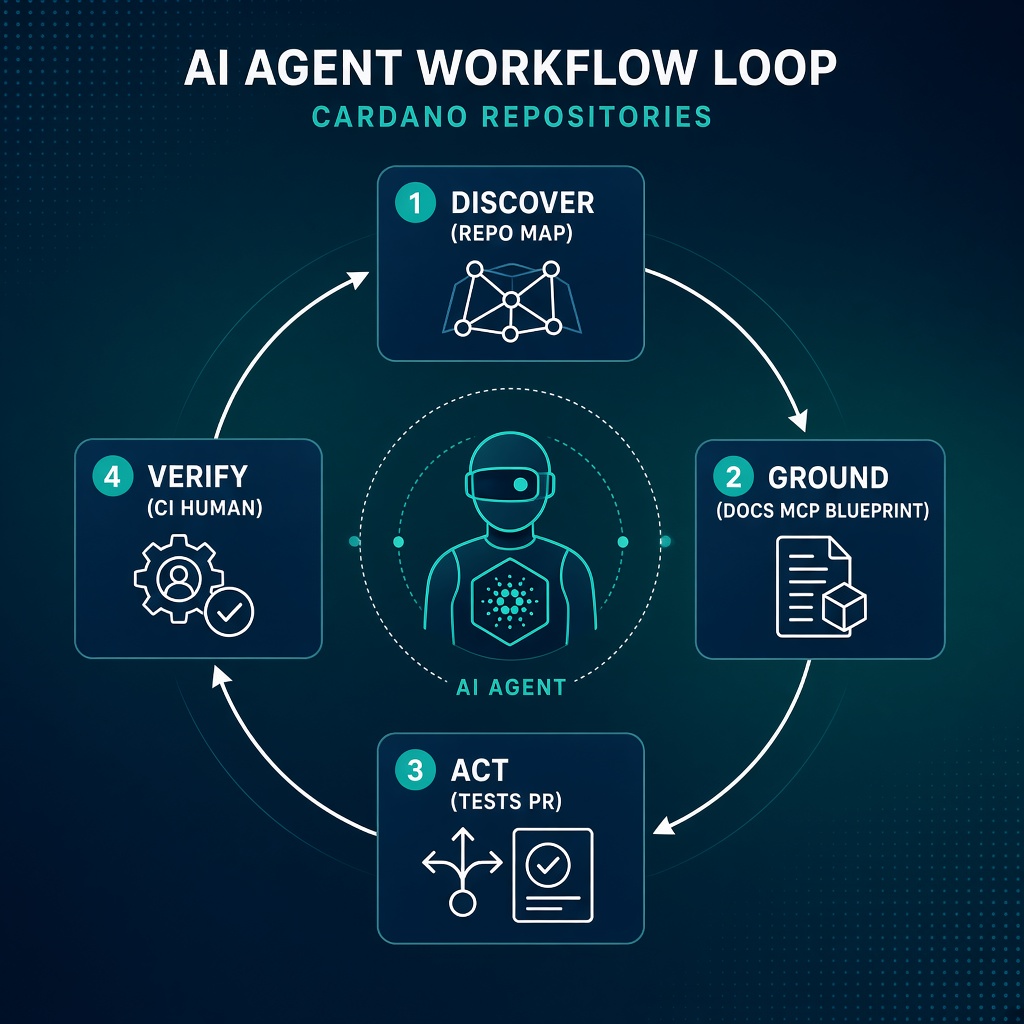
| Stage | Human experience | Agent experience (when repo is ready) |
|---|---|---|
| Discover | Skims README, asks in Discord | Reads a machine-clear map of packages, entrypoints, networks |
| Ground | Copies snippets, guesses versions | Pulls blueprint, pinned SDKs, MCP docs, reference patterns |
| Act | Writes a PR | Implements against tests / stubs first |
| Auto-verify | Waits on CI | CI + optional AI review filter noise |
| Human verify | Maintainer must approve before merge | Agent never merges; waits for human sign-off |
Why Cardano Repos Need Extra Design
Generic "AI-friendly repo" advice (clear README, lint, tests) is necessary but not sufficient on Cardano.
An agent can produce a green TypeScript build and still ship a validator that fails double-satisfaction review, burns ExUnits, or targets the wrong network. Repo readiness must encode Cardano correctness, not only compile success.
Slide Deck: What "AI-Ready" Looks Like
Slide 1 — Readiness Scorecard
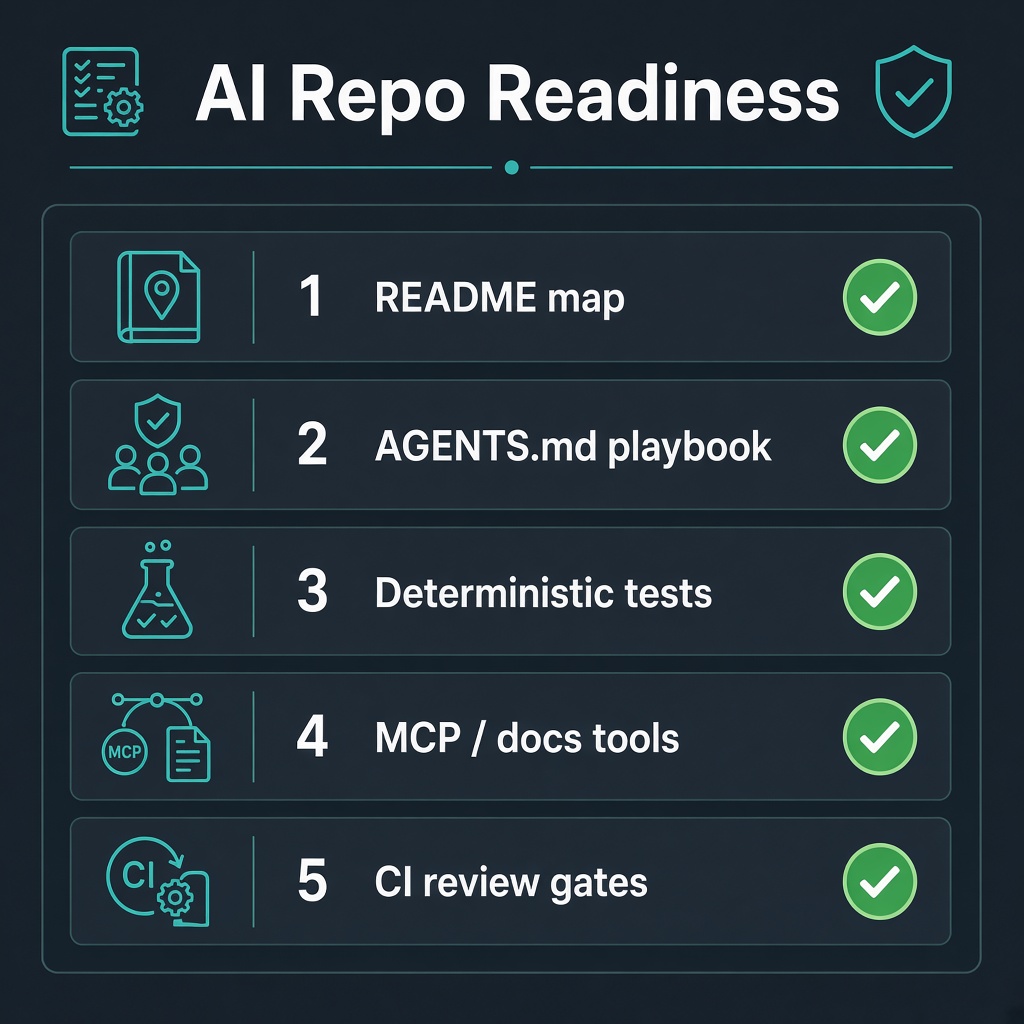
Score your own repo live (0–2 points each). 8+ is "agent-friendly"; under 5 is "agent roulette."
| # | Capability | Weak signal | Strong signal |
|---|---|---|---|
| 1 | Map | Sparse README | Architecture diagram + package map + "start here" path |
| 2 | Playbook | Tribal knowledge in maintainers' heads | AGENTS.md / rules / skills describing how to change code |
| 3 | Truth | Docs drift from code | Blueprint, schemas, pinned versions, MCP or skills for live docs |
| 4 | Tests | Manual smoke only | Deterministic unit / emulator tests agents can run |
| 5 | Gates | Merge on vibes / auto-merge on | Format, types, tests, optional AI review, then required human approval (no auto-merge) |
Slide 2 — Repository Layout Agents Can Parse
A concrete target layout for many Cardano projects:
repo/
├── README.md                 ← human + agent entry: purpose, map, networks
├── AGENTS.md                 ← how agents should work here (do / don't)
├── ARCHITECTURE.md           ← components, trust boundaries, data flow
├── docs/                     ← versioned how-tos (not only marketing)
├── onchain/
│   ├── validators/
│   └── plutus.json           ← blueprint = ground truth
├── offchain/ or sdk/
│   ├── package.json          ← pinned versions, scripts agents can run
│   └── examples/             ← golden paths (one script per flow)
├── .github/workflows/        ← verify before merge
└── .cursor/rules/ or skills/ ← optional editor/agent conventions
Names can vary. The contract cannot: entry map → playbook → truth → tests → auto-gates → human verification.
Slide 3 — Write AGENTS.md Like a Runbook
Treat it as instructions for a smart junior who has never seen Cardano before:
# AGENTS.md (pattern)

## Mission
What this repo does in one paragraph.

## Hard rules
- Do not invent SDK APIs; pin versions from package.json
- Prefer blueprint fields over guessed datum shapes
- Never "mutate state"; consume UTxOs and create new outputs
- Target network: Preview / Preprod / Mainnet (explicit)
- Never merge your own PR; always wait for human verification

## How to change code
1. Read ARCHITECTURE.md and the relevant blueprint section
2. Add / update tests first
3. Implement the smallest diff that passes tests
4. Run: npm test && npm run build
5. Open a draft PR and stop; a human must review and approve

## Do not
- Commit secrets
- Expand PR scope beyond the issue
- Skip ExUnits / signatory / double-satisfaction review for on-chain changes
- Enable or use auto-merge for AI-authored changes
- Treat green CI as permission to ship without a human
Slide 4 — Grounding Surfaces (Beyond Chat Paste)
| Surface | Agent use | Cardano-specific tip |
|---|---|---|
| Blueprint | Field names, hashes, script purposes | Prefer this over prose when schemas disagree |
| Pinned SDKs | Stop API mixing | Name the package + major version in the playbook |
| Examples | Few-shot patterns | Keep them green in CI |
| MCP | Live docs / chain tools | See Session 19; Mesh already ships skills + MCP |
| Rules / skills | Encode review habits | ExUnits, required signers, output pinning, human-must-approve |
Slide 5 — Maintainer View: Volume Without Chaos
As AI raises contribution volume, maintainers need filters, not more heroics. Automation prepares the PR; a human always owns the merge decision.
Practical defaults (also from Session 18):
- Keep PRs in draft until automated checks pass.
- Optional AI review may summarize risk; it cannot approve or merge.
- Require at least one human code owner / maintainer approval on protected branches.
- Leave auto-merge off for AI-assisted contributions (especially on-chain / SDK / secrets-adjacent paths).
Discussion Agenda (Live Session)
Use these prompts to collect ecosystem practice, not only theory:
- What broke first when you pointed an agent at a Cardano repo?
- Which single file would have saved the most tokens / retries?
- Should Intersect / DevEx publish a shared
AGENTS.mdtemplate for Cardano repos? - Which repos should ship MCP first: on-chain languages, SDKs, or infrastructure?
- How do we keep human verification always required as agents get faster (branch rules, CODEOWNERS, no auto-merge)?
Capture answers in the recording notes and feed them into a follow-up checklist PR if the WG agrees.
Working Checklist: Make Your Repo AI-Ready This Week
- One-screen map in README (packages, networks, "run this first")
- Add
AGENTS.md(or equivalent rules/skills) with hard Cardano constraints and "wait for human approval" - Link the blueprint and declare pinned off-chain versions
- Ensure one golden example runs headlessly in CI
- Add or tighten verify workflow (format, types, tests)
- Document review risks for on-chain diffs (signers, outputs, ExUnits)
- Enforce human verification: branch protection, required reviewers / CODEOWNERS, auto-merge off
- Optional: expose docs via MCP / skills for agent grounding
Continuity With Prior Sessions
| Session | What it gave us | How Session 22 uses it |
|---|---|---|
| 18 · AI Dev Workflow | Orchestrate, ground, TDD, audit | Repo must host those grounding surfaces |
| 19 · Cardano MCP | Live tools for agents | Repos should declare which MCP/tools they expect |
| 21 · Production SDK | Blueprint → SDK → examples → CI | That stack is the AI-ready pattern in practice |
Key Takeaways
- PR volume and risk are rising with AI developers and agents; some diffs are noisy, some are malicious.
- Protect repos with CI automation + AI review + required human verification (never auto-merge).
- AI-ready is a repo property, not a model property.
- Design for the loop: Discover → Ground → Act → Auto-verify → Human verify.
- Encode Cardano truth locally: blueprint, pins, examples, tests.
- Give agents a playbook (
AGENTS.md/ rules) that forbids account-model assumptions. - Treat tonight's discussion as input to a shared DevEx template for the ecosystem.
These notes belong to the Q4 2026 Developer Experience Working Group.